Commonly Used Terms in Special Ed
Plain meanings and examples for 64 words you will hear.
Glossary by Linda Fokam, Education & Development Intern
64 words in this glossary. Type one you heard at a meeting.
Some pages of this design had not loaded yet, so they are left out. To print every page, use “Print it” on the page.
64 words in this glossary. Type one you heard at a meeting.
See all 64 words in larger textThe same words as the design, in the same order
Text version of Commonly Used Terms in Special Ed
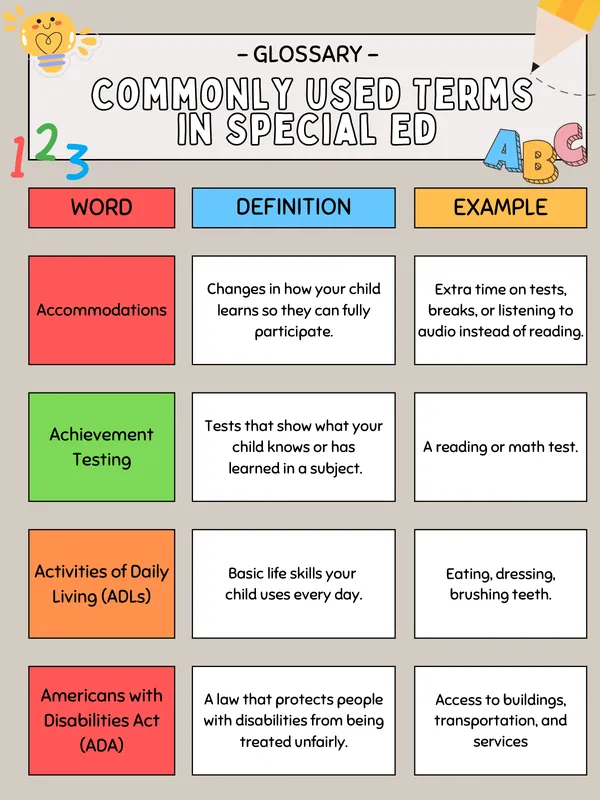
- Accommodations
- Changes in how your child learns so they can fully participate.Example: Extra time on tests, breaks, or listening to audio instead of reading.
- Achievement Testing
- Tests that show what your child knows or has learned in a subject.Example: A reading or math test.
- Activities of Daily Living (ADLs)
- Basic life skills your child uses every day.Example: Eating, dressing, brushing teeth.
- Americans with Disabilities Act (ADA)
- A law that protects people with disabilities from being treated unfairly.Example: Access to buildings, transportation, and services
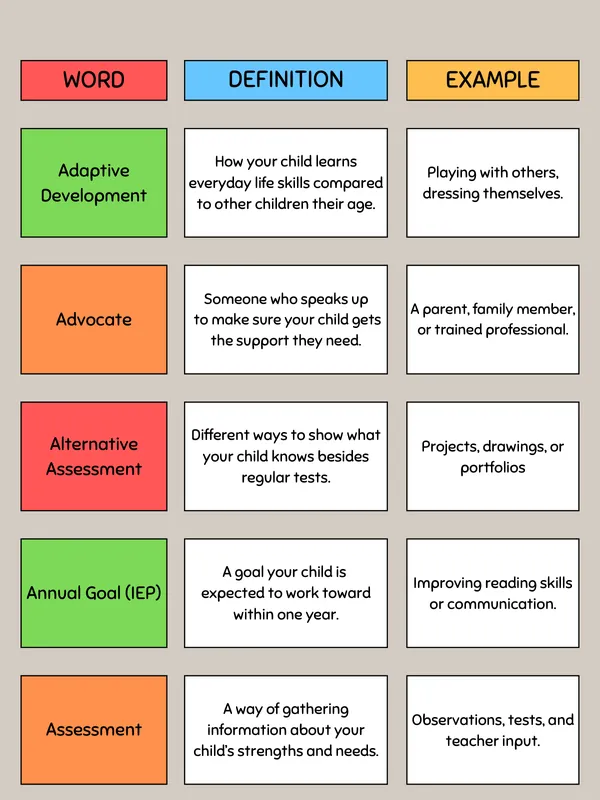
- Adaptive Development
- How your child learns everyday life skills compared to other children their age.Example: Playing with others, dressing themselves.
- Advocate
- Someone who speaks up to make sure your child gets the support they need.Example: A parent, family member, or trained professional.
- Alternative Assessment
- Different ways to show what your child knows besides regular tests.Example: Projects, drawings, or portfolios
- Annual Goal (IEP)
- A goal your child is expected to work toward within one year.Example: Improving reading skills or communication.
- Assessment
- A way of gathering information about your child’s strengths and needs.Example: Observations, tests, and teacher input.
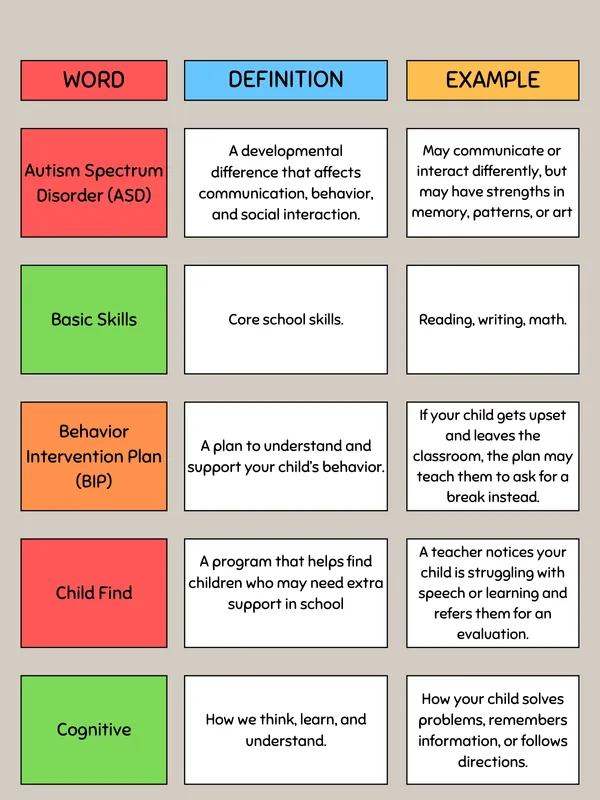
- Autism Spectrum Disorder (ASD)
- A developmental difference that affects communication, behavior, and social interaction.Example: May communicate or interact differently, but may have strengths in memory, patterns, or art
- Basic Skills
- Core school skills.Example: Reading, writing, math.
- Behavior Intervention Plan (BIP)
- A plan to understand and support your child’s behavior.Example: If your child gets upset and leaves the classroom, the plan may teach them to ask for a break instead.
- Child Find
- A program that helps find children who may need extra support in schoolExample: A teacher notices your child is struggling with speech or learning and refers them for an evaluation.
- Cognitive
- How we think, learn, and understand.Example: How your child solves problems, remembers information, or follows directions.
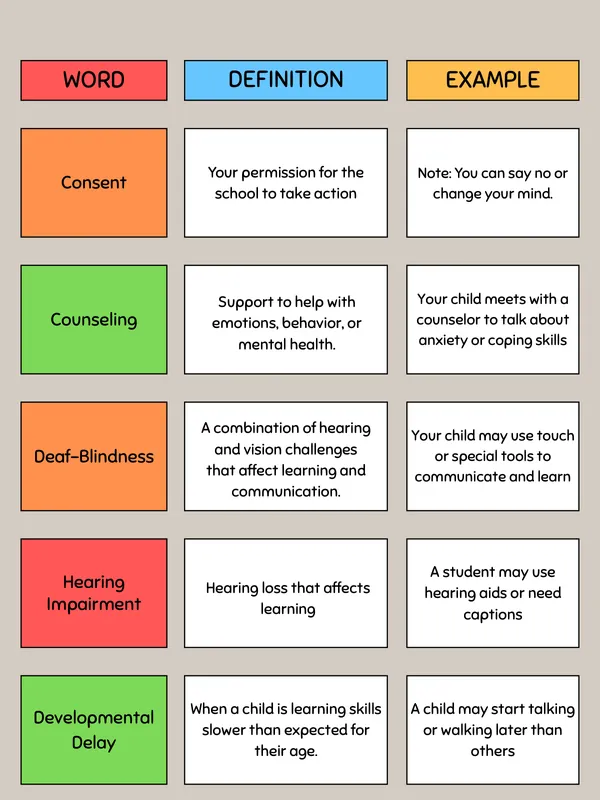
- Consent
- Your permission for the school to take actionNote: You can say no or change your mind.
- Counseling
- Support to help with emotions, behavior, or mental health.Example: Your child meets with a counselor to talk about anxiety or coping skills
- Deaf-Blindness
- A combination of hearing and vision challenges that affect learning and communication.Example: Your child may use touch or special tools to communicate and learn
- Hearing Impairment
- Hearing loss that affects learningExample: A student may use hearing aids or need captions
- Developmental Delay
- When a child is learning skills slower than expected for their age.Example: A child may start talking or walking later than others
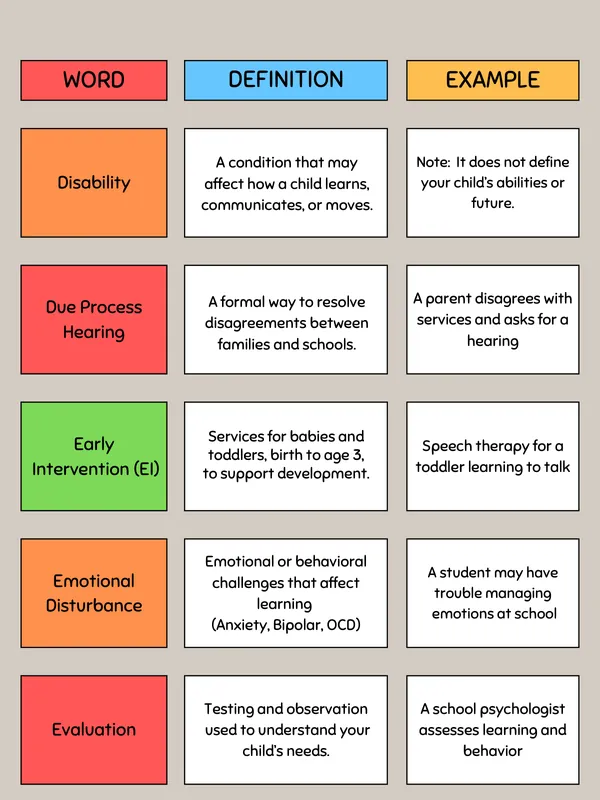
- Disability
- A condition that may affect how a child learns, communicates, or moves.Note: It does not define your child’s abilities or future.
- Due Process Hearing
- A formal way to resolve disagreements between families and schools.Example: A parent disagrees with services and asks for a hearing
- Early Intervention (EI)
- Services for babies and toddlers, birth to age 3, to support development.Example: Speech therapy for a toddler learning to talk
- Emotional Disturbance
- Emotional or behavioral challenges that affect learning (Anxiety, Bipolar, OCD)Example: A student may have trouble managing emotions at school
- Evaluation
- Testing and observation used to understand your child’s needs.Example: A school psychologist assesses learning and behavior
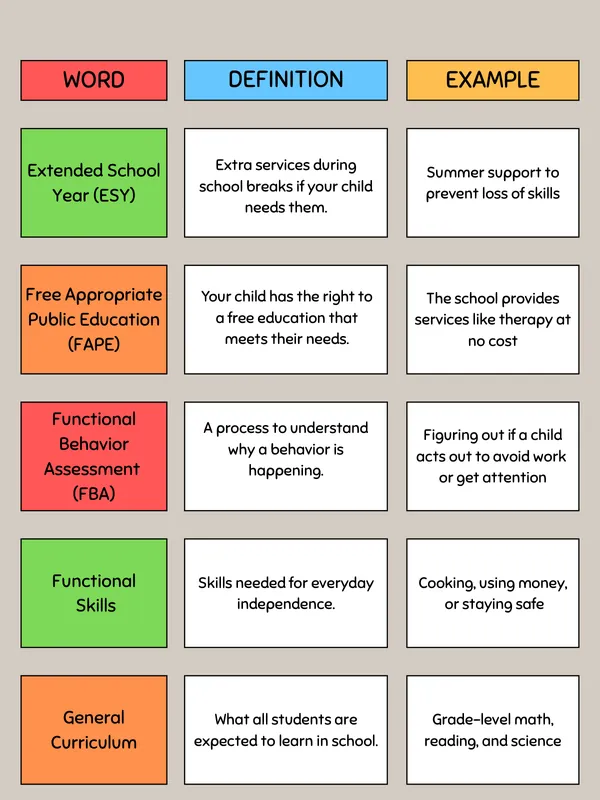
- Extended School Year (ESY)
- Extra services during school breaks if your child needs them.Example: Summer support to prevent loss of skills
- Free Appropriate Public Education (FAPE)
- Your child has the right to a free education that meets their needs.Example: The school provides services like therapy at no cost
- Functional Behavior Assessment (FBA)
- A process to understand why a behavior is happening.Example: Figuring out if a child acts out to avoid work or get attention
- Functional Skills
- Skills needed for everyday independence.Example: Cooking, using money, or staying safe
- General Curriculum
- What all students are expected to learn in school.Example: Grade-level math, reading, and science
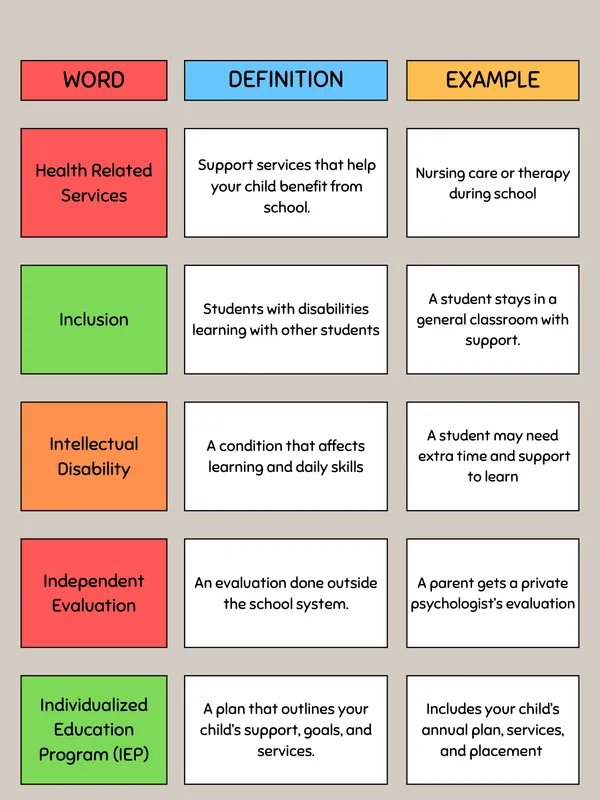
- Health Related Services
- Support services that help your child benefit from school.Example: Nursing care or therapy during school
- Inclusion
- Students with disabilities learning with other studentsExample: A student stays in a general classroom with support.
- Intellectual Disability
- A condition that affects learning and daily skillsExample: A student may need extra time and support to learn
- Independent Evaluation
- An evaluation done outside the school system.Example: A parent gets a private psychologist’s evaluation
- Individualized Education Program (IEP)
- A plan that outlines your child’s support, goals, and services.Example: Includes your child’s annual plan, services, and placement
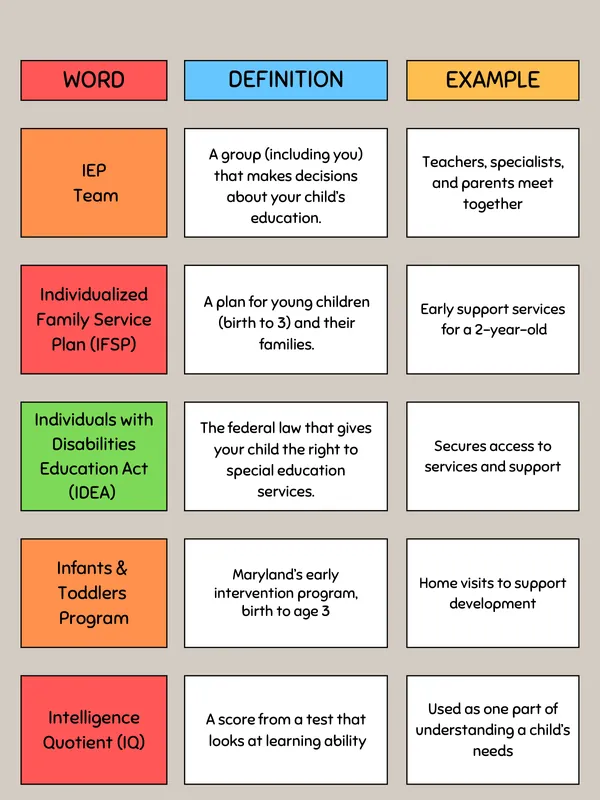
- IEP Team
- A group (including you) that makes decisions about your child’s education.Example: Teachers, specialists, and parents meet together
- Individualized Family Service Plan (IFSP)
- A plan for young children (birth to 3) and their families.Example: Early support services for a 2-year-old
- Individuals with Disabilities Education Act (IDEA)
- The federal law that gives your child the right to special education services.Example: Secures access to services and support
- Infants & Toddlers Program
- Maryland’s early intervention program, birth to age 3Example: Home visits to support development
- Intelligence Quotient (IQ)
- A score from a test that looks at learning abilityExample: Used as one part of understanding a child’s needs
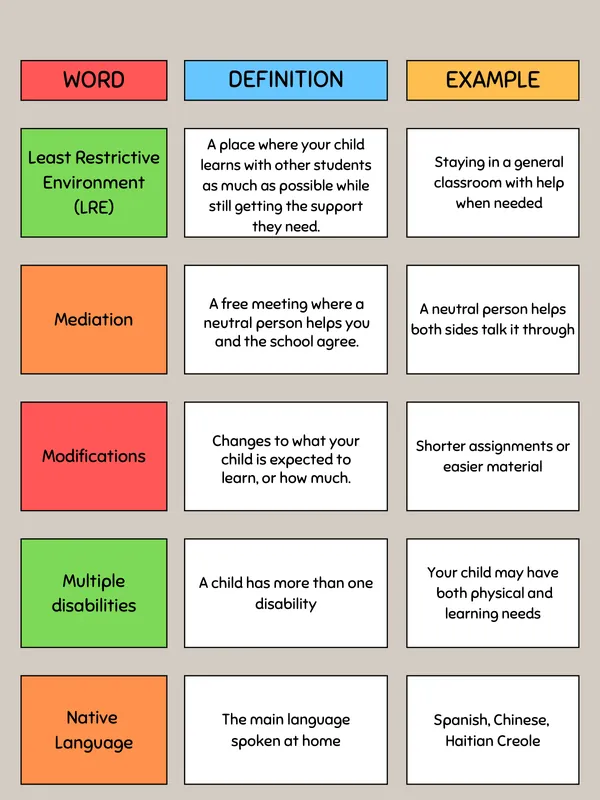
- Least Restrictive Environment (LRE)
- A place where your child learns with other students as much as possible while still getting the support they need.Example: Staying in a general classroom with help when needed
- Mediation
- A free meeting where a neutral person helps you and the school agree.Example: A neutral person helps both sides talk it through
- Modifications
- Changes to what your child is expected to learn, or how much.Example: Shorter assignments or easier material
- Multiple disabilities
- A child has more than one disabilityExample: Your child may have both physical and learning needs
- Native Language
- The main language spoken at homeExample: Spanish, Chinese, Haitian Creole
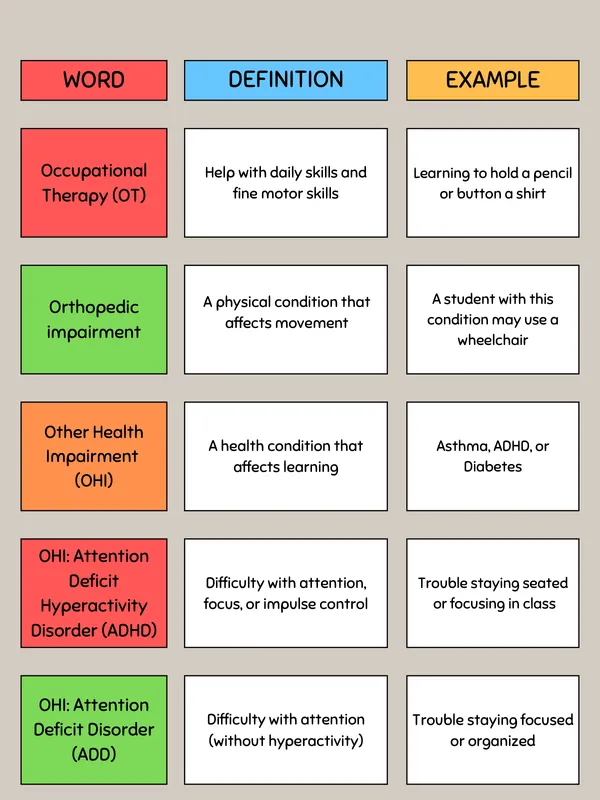
- Occupational Therapy (OT)
- Help with daily skills and fine motor skillsExample: Learning to hold a pencil or button a shirt
- Orthopedic impairment
- A physical condition that affects movementExample: A student with this condition may use a wheelchair
- Other Health Impairment (OHI)
- A health condition that affects learningExample: Asthma, ADHD, or Diabetes
- OHI: Attention Deficit Hyperactivity Disorder (ADHD)
- Difficulty with attention, focus, or impulse controlExample: Trouble staying seated or focusing in class
- OHI: Attention Deficit Disorder (ADD)
- Difficulty with attention (without hyperactivity)Example: Trouble staying focused or organized
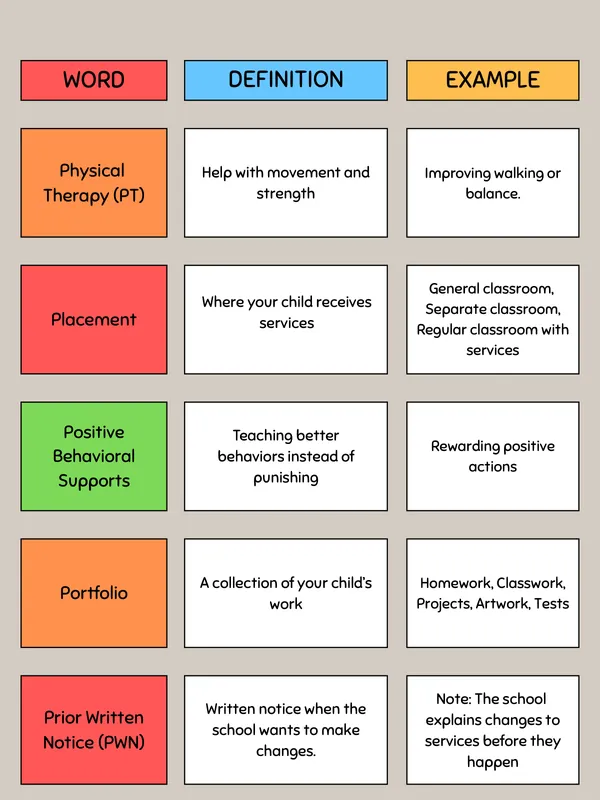
- Physical Therapy (PT)
- Help with movement and strengthExample: Improving walking or balance.
- Placement
- Where your child receives servicesExample: General classroom, Separate classroom, Regular classroom with services
- Positive Behavioral Supports
- Teaching better behaviors instead of punishingExample: Rewarding positive actions
- Portfolio
- A collection of your child’s workExample: Homework, Classwork, Projects, Artwork, Tests
- Prior Written Notice (PWN)
- Written notice when the school wants to make changes.Note: The school explains changes to services before they happen
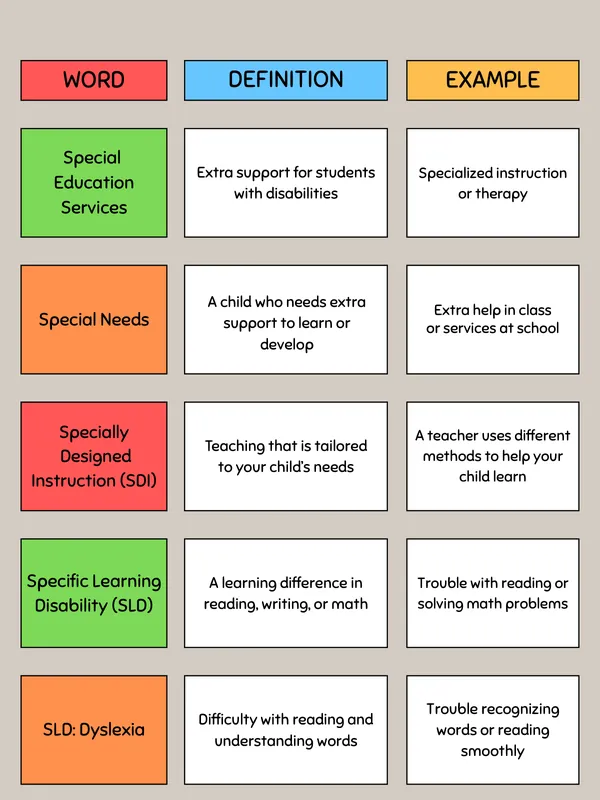
- Special Education Services
- Extra support for students with disabilitiesExample: Specialized instruction or therapy
- Special Needs
- A child who needs extra support to learn or developExample: Extra help in class or services at school
- Specially Designed Instruction (SDI)
- Teaching that is tailored to your child’s needsExample: A teacher uses different methods to help your child learn
- Specific Learning Disability (SLD)
- A learning difference in reading, writing, or mathExample: Trouble with reading or solving math problems
- SLD: Dyslexia
- Difficulty with reading and understanding wordsExample: Trouble recognizing words or reading smoothly
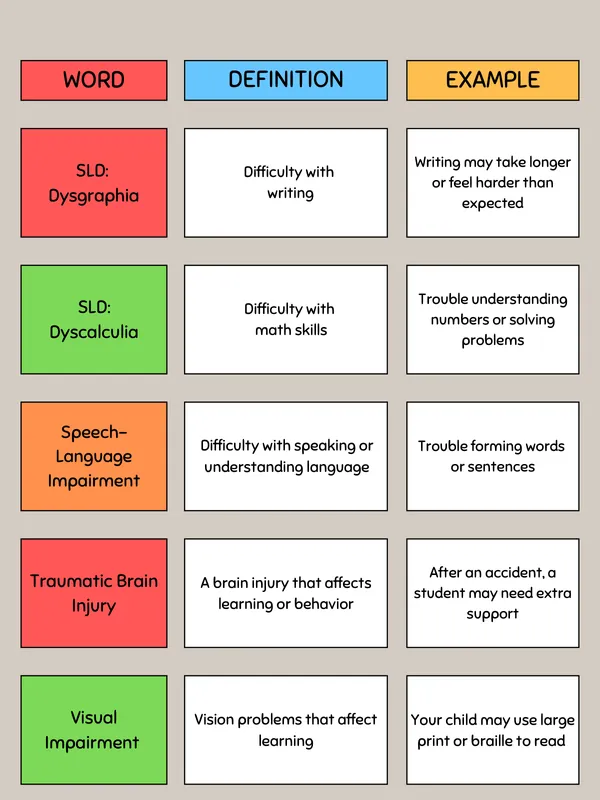
- SLD: Dysgraphia
- Difficulty with writingExample: Writing may take longer or feel harder than expected
- SLD: Dyscalculia
- Difficulty with math skillsExample: Trouble understanding numbers or solving problems
- Speech-Language Impairment
- Difficulty with speaking or understanding languageExample: Trouble forming words or sentences
- Traumatic Brain Injury
- A brain injury that affects learning or behaviorExample: After an accident, a student may need extra support
- Visual Impairment
- Vision problems that affect learningExample: Your child may use large print or braille to read
From The Parents’ Place of Maryland
Fact sheets that go with this tool, from Maryland’s free parent center.
- IDEA Eligibility Categories (opens a new tab)The official names behind the disability words in this glossary. The 13 disability categories in federal law, and what it takes for a child to qualify.
Free help in Maryland. A Family Partner at The Parents’ Place can help you prepare for a meeting and understand your rights, in English or Spanish.
Contact a Family Partner (opens a new tab)or call 410-768-9100
In DC or Virginia? Find your parent center.
Commonly Used Terms in Special Ed. Glossary by Linda Fokam, Education & Development Intern. Guiding Hands, a free toolkit from The ABLE Foundation · ABLEtheFoundation.org/guiding-hands/words-to-know · General information, not legal advice. Reviewed October 2026.
Empowered by information. This toolkit serves as an informative resource but does not take the place of legal advice, your child’s school team, federally appointed parent support centers, or advocates/lawyers. Each state (i.e., Maryland, DC, Virginia) has their own rules. Please be sure to consult your local representatives and organizations for more information. Read the full notice