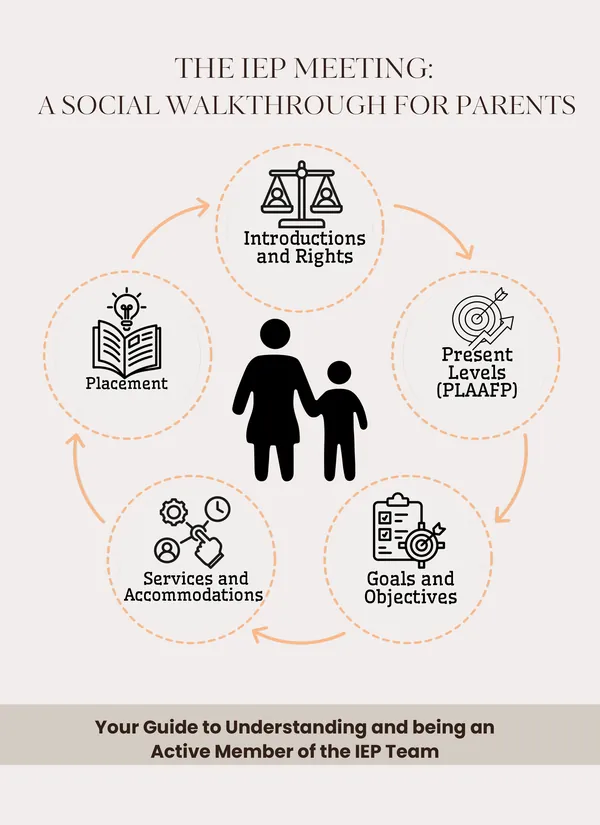
The IEP Meeting: A Social Walkthrough for Parents
How the meeting goes, phase by phase, and your part in each.
Social script for parents by Linda Fokam, Education & Development Intern
Some pages of this design had not loaded yet, so they are left out. To print every page, use “Print it” on the page.
Read it in larger textThe same words as the design, easier to read on a phone and read aloud by screen readers
Text version of The IEP Meeting: A Social Walkthrough for Parents
Your guide to understanding and being an active member of the IEP team. The meeting has five phases: Introductions and Rights, Present Levels (PLAAFP), Goals and Objectives, Services and Accommodations and Placement.
Purpose of the social script
This social script is to help caregivers stay organized and confident during their child’s IEP meeting. The goal of this resource is to help you follow the process, remind you of your rights, and participate as an equal partner on the team.
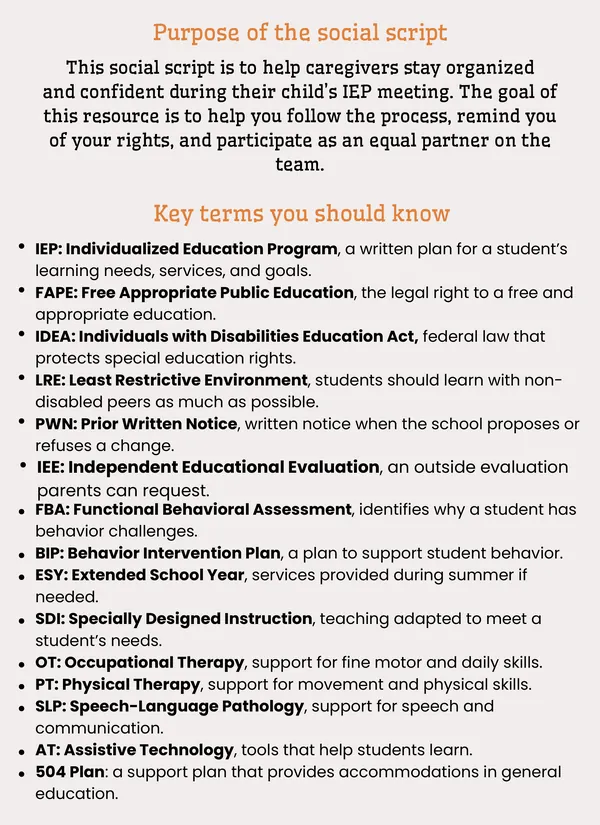
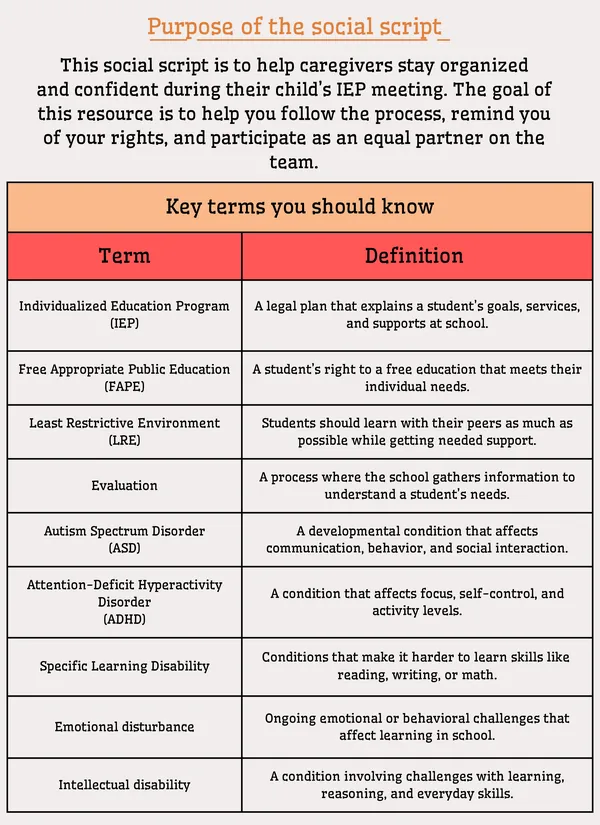
Key terms you should know
- IEP
- Individualized Education Program, a written plan for a student’s learning needs, services, and goals.
- FAPE
- Free Appropriate Public Education, the legal right to a free and appropriate education.
- IDEA
- Individuals with Disabilities Education Act, federal law that protects special education rights.
- LRE
- Least Restrictive Environment, students should learn with non-disabled peers as much as possible.
- PWN
- Prior Written Notice, written notice when the school proposes or refuses a change.
- IEE
- Independent Educational Evaluation, an outside evaluation parents can request.
- FBA
- Functional Behavioral Assessment, identifies why a student has behavior challenges.
- BIP
- Behavior Intervention Plan, a plan to support student behavior.
- ESY
- Extended School Year, services provided during summer if needed.
- SDI
- Specially Designed Instruction, teaching adapted to meet a student’s needs.
- OT
- Occupational Therapy, support for fine motor and daily skills.
- PT
- Physical Therapy, support for movement and physical skills.
- SLP
- Speech-Language Pathology, support for speech and communication.
- AT
- Assistive Technology, tools that help students learn.
- 504 Plan
- A support plan that provides accommodations in general education.
- Individualized Education Program (IEP)
- A legal plan that explains a student’s goals, services, and supports at school.
- Free Appropriate Public Education (FAPE)
- A student’s right to a free education that meets their individual needs.
- Least Restrictive Environment (LRE)
- Students should learn with their peers as much as possible while getting needed support.
- Evaluation
- A process where the school gathers information to understand a student’s needs.
- Autism Spectrum Disorder (ASD)
- A developmental condition that affects communication, behavior, and social interaction.
- Attention-Deficit Hyperactivity Disorder (ADHD)
- A condition that affects focus, self-control, and activity levels.
- Specific Learning Disability
- Conditions that make it harder to learn skills like reading, writing, or math.
- Emotional disturbance
- Ongoing emotional or behavioral challenges that affect learning in school.
- Intellectual disability
- A condition involving challenges with learning, reasoning, and everyday skills.
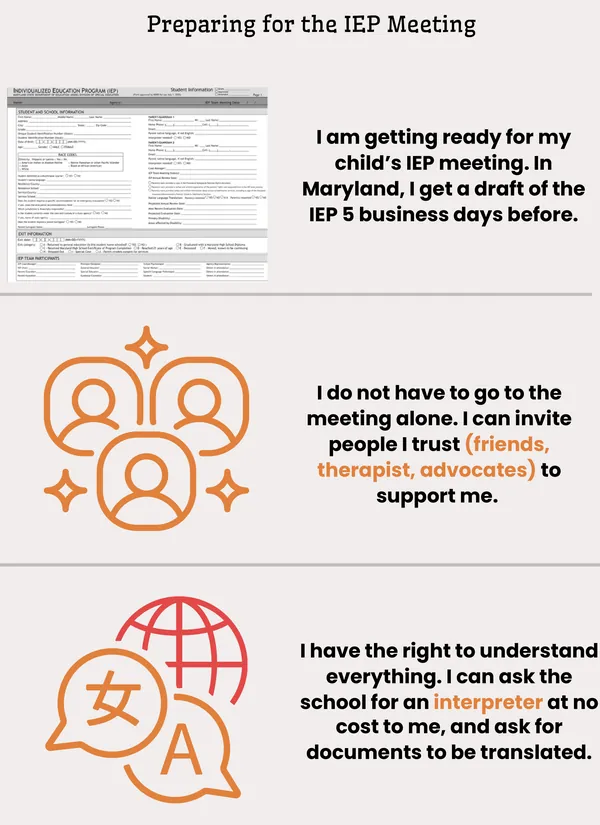
Preparing for the IEP meeting
- I am getting ready for my child’s IEP meeting. In Maryland, I get a draft of the IEP 5 business days before.
- I do not have to go to the meeting alone. I can invite people I trust (friends, therapist, advocates) to support me.
- I have the right to understand everything. I can ask the school for an interpreter at no cost to me, and ask for documents to be translated.
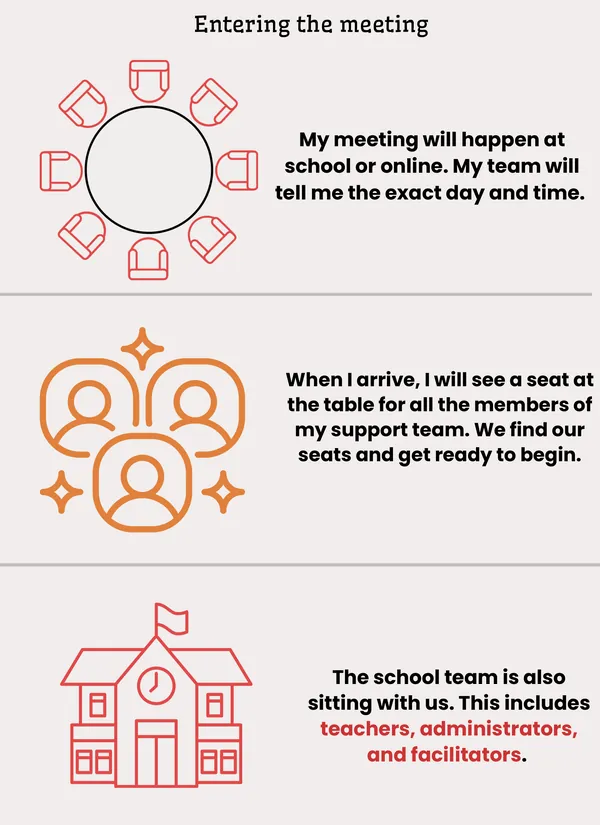
Entering the meeting
- My meeting will happen at school or online. My team will tell me the exact day and time.
- When I arrive, I will see a seat at the table for all the members of my support team. We find our seats and get ready to begin.
- The school team is also sitting with us. This includes teachers, administrators, and facilitators.
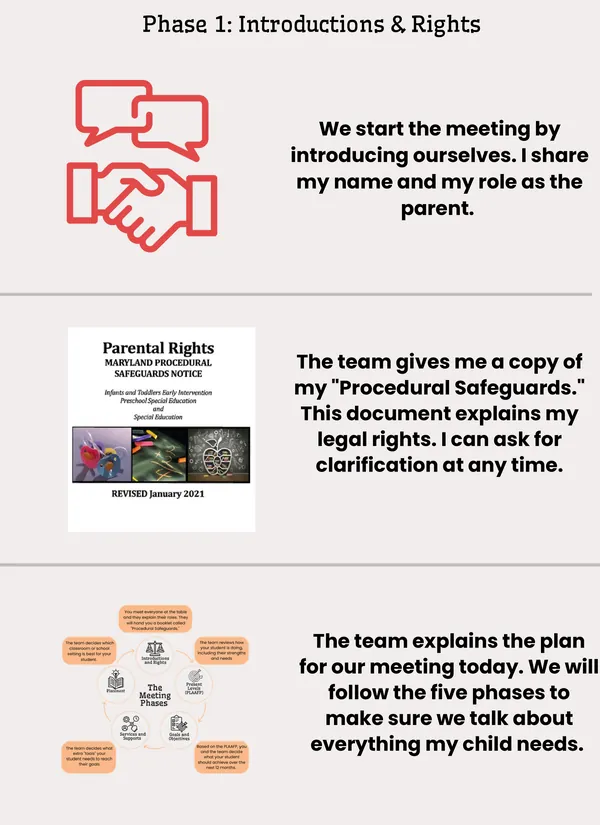
Phase 1: Introductions & Rights
- We start the meeting by introducing ourselves. I share my name and my role as the parent.
- The team gives me a copy of my “Procedural Safeguards.” This document explains my legal rights. I can ask for clarification at any time.
- The team explains the plan for our meeting today. We will follow the five phases to make sure we talk about everything my child needs.
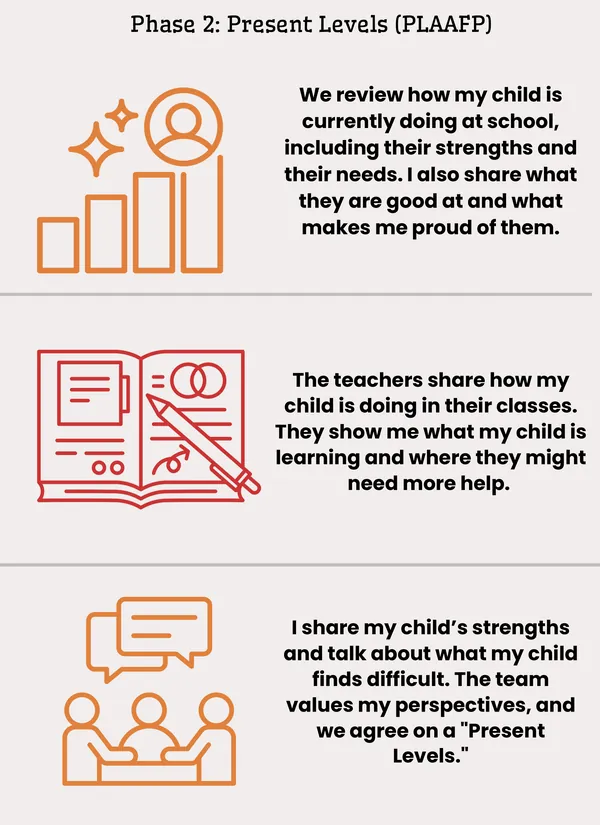
Phase 2: Present Levels (PLAAFP)
- We review how my child is currently doing at school, including their strengths and their needs. I also share what they are good at and what makes me proud of them.
- The teachers share how my child is doing in their classes. They show me what my child is learning and where they might need more help.
- I share my child’s strengths and talk about what my child finds difficult. The team values my perspectives, and we agree on a “Present Levels.”
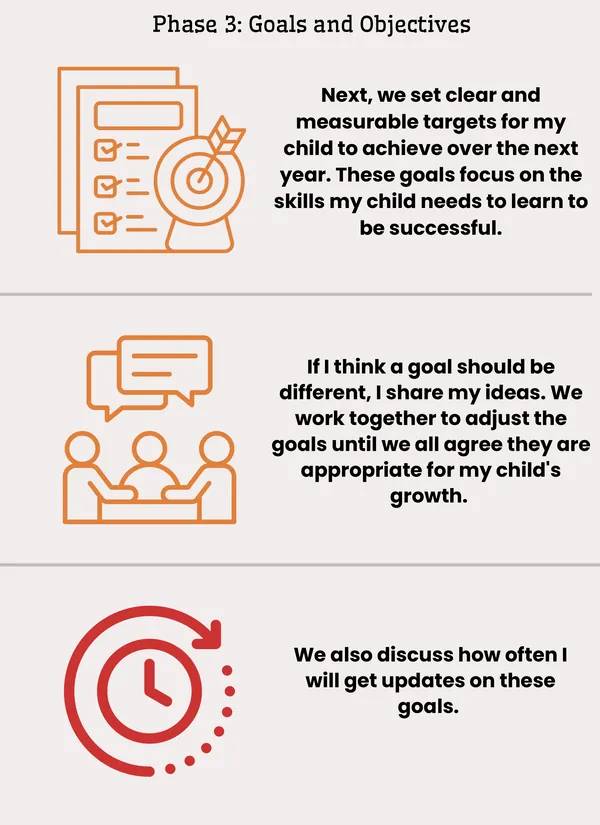
Phase 3: Goals and Objectives
- Next, we set clear and measurable targets for my child to achieve over the next year. These goals focus on the skills my child needs to learn to be successful.
- If I think a goal should be different, I share my ideas. We work together to adjust the goals until we all agree they are appropriate for my child’s growth.
- We also discuss how often I will get updates on these goals.
Phase 4: Services and Accommodations
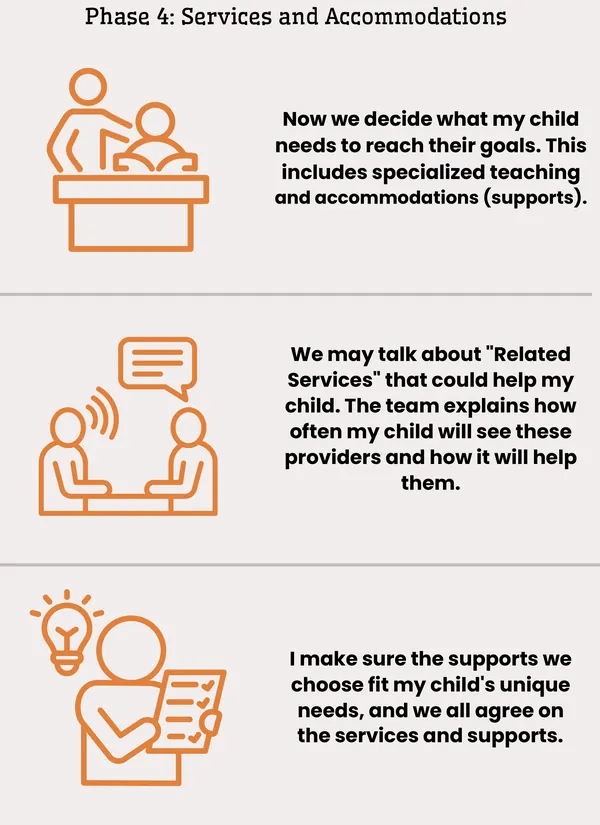
- Now we decide what my child needs to reach their goals. This includes specialized teaching and accommodations (supports).
- We may talk about “Related Services” that could help my child. The team explains how often my child will see these providers and how it will help them.
- I make sure the supports we choose fit my child’s unique needs, and we all agree on the services and supports.
Phase 5: Placement
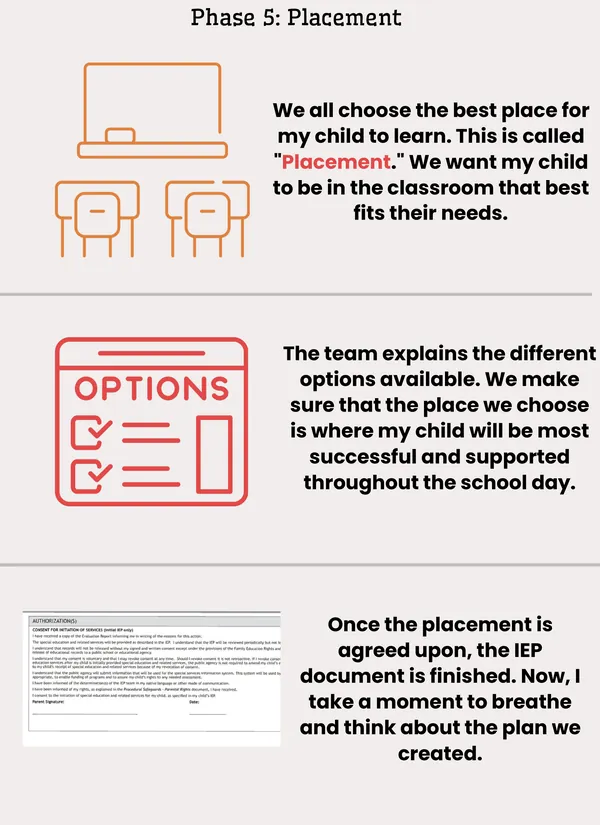
- We all choose the best place for my child to learn. This is called “Placement.” We want my child to be in the classroom that best fits their needs.
- The team explains the different options available. We make sure that the place we choose is where my child will be most successful and supported throughout the school day.
- Once the placement is agreed upon, the IEP document is finished. Now, I take a moment to breathe and think about the plan we created.
After the meeting
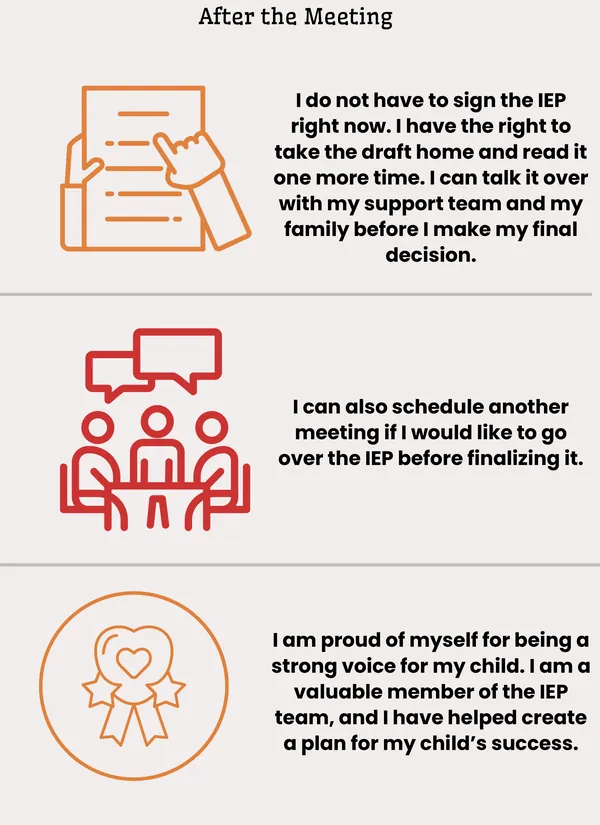
- I do not have to sign the IEP right now. I have the right to take the draft home and read it one more time. I can talk it over with my support team and my family before I make my final decision.
- I can also schedule another meeting if I would like to go over the IEP before finalizing it.
- I am proud of myself for being a strong voice for my child. I am a valuable member of the IEP team, and I have helped create a plan for my child’s success.
From The Parents’ Place of Maryland
Fact sheets that go with this tool, from Maryland’s free parent center.
- S.M.A.R.T. IEP Goals: Questions to Consider (opens a new tab)For Phase 3, goals and objectives. What makes an IEP goal specific and measurable, with examples.
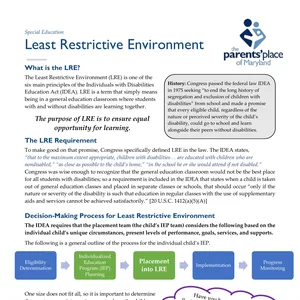
- Least Restrictive Environment (opens a new tab)For Phase 5, placement. What LRE means, how the team decides where your child learns, and questions to ask.
Free help in Maryland. A Family Partner at The Parents’ Place can help you prepare for a meeting and understand your rights, in English or Spanish.
Contact a Family Partner (opens a new tab)or call 410-768-9100
In DC or Virginia? Find your parent center.
The IEP Meeting: A Social Walkthrough for Parents. Social script for parents by Linda Fokam, Education & Development Intern. Guiding Hands, a free toolkit from The ABLE Foundation · ABLEtheFoundation.org/guiding-hands/meeting-walkthrough · General information, not legal advice. Reviewed October 2026.
Empowered by information. This toolkit serves as an informative resource but does not take the place of legal advice, your child’s school team, federally appointed parent support centers, or advocates/lawyers. Each state (i.e., Maryland, DC, Virginia) has their own rules. Please be sure to consult your local representatives and organizations for more information. Read the full notice